Seminars
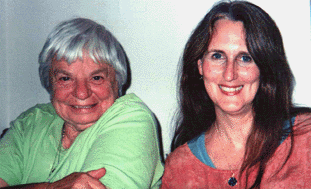
Dolores Krieger & Shirley Spear Begley
"Shirley demonstrates a mature, compassionate, but pragmatic concern for those in need. As a professional nurse her practice reflects a high level of expertise and ethical behavior. As a teacher, she excels. It is with confidence and great pleasure that I recommend her very highly to you."
- Dolores Krieger, PhD, RN, Professor Emerita, New York University
“The Energetic Language of
Therapeutic Touch”
A Basic TT Seminar
(click Title for Flier with All
Seminar Details)
For Next Course Information go to this link:
Basic TT, Practicum and Healing Retreat
Introduction To Therapeutic Touch
Introduction to TT University of South Florida College of Social Work
Introduction to TT University of Tampa, College of Nursing
"Therapeutic Touch as Transpersonal Healing"
with
Dolores Krieger, PhD, RN
BASIC THERAPEUTIC TOUCH - Part I & II
Therapeutic Touch (TT) (Krieger-Kunz model) is a consciously directed process of energy exchange derived from several ancient healing practices that intentionally uses the hands to facilitate healing. Started in 1972 by Dolores Krieger, PhD, RN, Professor Emerita, New York University and Dora Kunz, a natural healer, TT was taught in the Master's Program in the Department of Nursing and continues to be taught in more than 200 US universities and medical centers, and in 104 countries abroad. Graduate, doctoral and post-doctoral research continues to validate its effectiveness.
OBJECTIVES
1. Identify basic assumptions and framework central to Therapeutic Touch.
2. Discuss basic nursing research regarding the effectiveness of TT.
3. Apply the phases of the TT process during supervised practice sessions at the basic level of competence.
4. Discuss indications and considerations for implementing TT in various clinical practices.
"Shirley demonstrates a mature, compassionate, but pragmatic concern for those in need. As a professional nurse her practice reflects a high level of expertise and ethical behavior. As a teacher, she excels. It is with confidence and great pleasure that I recommend her very highly to you."
- Dolores Krieger, PhD, RN, Professor Emerita, New York University
INTERMEDIATE
THERAPEUTIC TOUCH - Part III
(Prerequisite - Basic TT)
OBJECTIVES
1. Demonstrate the process of Therapeutic Touch (TT) at the Intermediate level of expertise during supervised practice sessions.
2. Explore the use of complementary interventions as they relate to TT: 4 basic energy fields, 7 major energy centers, color, sound and imagery and their relationships to energy modulation.
3. Evaluate additional theoretical frameworks and current research which support the process of TT.
4. Examine the personal foundations and meditative aspects necessary for deepening the practice of the TT process and a healing lifestyle.
5. Discuss methods of integrating TT into the clinical practice setting, as an extension of professional skills including applications, ethics, resources, documentation, and reimbursement.
Prerequisites: Basic, Intermediate and Mentorship
in TT.
For experienced TT practitioners who have minimally advanced through the above sequence of courses and mentorship. Advanced energetic healing concepts are the focus of this course. Practicum in clinical setting is recommended.
Guided Imagery
The Power of Imagination to
Improve Health & Well-Being
Imagery is one of the most ancient healing methods known in history dating back hundreds of years to various cultures. In Grecian times, Hippocrates, The father of medicine, spoke of imagination's central role in health and illness. Albert Einstein stated that imagination is more important than knowledge. In recent times, cancer researchers and motivational psychologists have utilized cellular and physiological imagery to aid recovery in medical conditions.
With the recent growth in awareness of the mind/body/spirit connection, Guided Imagery is again being utilized, as a means of helping others in their quest for healing. Guided Imagery involves us in our own healing by creating positive experiences of relaxation, a key to tapping our own healing abilities. A sense of control over one's life has been identified as an important means of improving one's health. Guided Imagery enhances this potential leading to greater insight, sensitivity and wholeness. Many health conditions have been identified as benefiting from regular Guided Imagery, helping people attain greater health and happiness. Come learn this powerful technique!
OBJECTIVES:
1. Explore the history of Guided Imagery, current medical usages, and how and why it works.
2. Learn various forms of Guided Imagery, relaxation, and visualization to increase therapeutic presence and the healing interaction.
3. Perform Guided Imagery methods under the supervision of an advanced practitioner.
4. Identify benefits of incorporating Guided Imagery into clinical practice related to specific conditions.
Holistic Healthcare and Nursing
Practicum
Photo above by Shelley Mackey, 2000
 The Healing Art of
Caring™
The Healing Art of
Caring™